Climate Adaptation and Resilience – The Next Frontier For Blended Finance

Kumar Subramanian
Founding Partner & Managing Director,
Sculpt Partners
Aditya Vikram Jindal
Research Intern, Sculpt Partners
Sculpt Partners is a sustainability oriented advisory firm and works with public-listed corporations, social ventures and non-profits, and sustainable, responsible and impact investors, to solve the planet’s most pressing challenges. Its mission is to stimulate capital, capacity and capabilities required to solve key environment, economic and social issues that challenge the planet. To accomplish this mission, Sculpt Partners help early-stage ventures, public-listed corporations, and Sustainable, Responsible and Impact (SRI) investors towards better articulation, stewardship and execution of the corporate sustainability agenda.
Climate Adaptation and Resilience – The Next Frontier For Blended Finance
Climate science has proven the adverse effects of global warming beyond doubt. Global mean temperatures are approximately 1.4°C above the 1850–1900 average, with 2023 as the warmest year on record. There is also a vast body of research that supports the direct and indirect impacts of climate change, especially in countries that constitute the Global South. The Mckinsey Global Institute 2020 report projects that by 2030, deadly heatwaves in India could imperil 160-200 million people and cause productivity losses amounting to 2.5%-4.5% of the country’s Gross Domestic Product (GDP).
Addressing the climate crisis demands a multifaceted approach that encompasses mitigation, adaptation, and resilience-building. Mitigation efforts aim to limit greenhouse gas (GHG) emissions and decelerate global warming. Adaptation measures focus on preparing for and responding to the impacts of climate change, while resilience-building strengthens communities' ability to withstand and recover.
A disproportionate emphasis on climate change mitigation vis-à-vis adaptation and resilience
The United Nations Environment Programme (UNEP) Adaptation Finance Gap Report estimates that adaptation finance needs in developing countries will reach $140 -$300 billion per year by 2030, and $280-$500 billion per year by 2050. During COP26, COP27 and COP28 state actors pledged an Adaptation fund and a Loss and Damage fund totalling about $1 billion, hardly sufficient to tackle the enormity of this challenge. In 2021/2022, the Climate Policy Initiative (CPI) estimated $1.15 trillion of capital flows towards climate mitigation. In contrast, a mere $63 billion of global climate financing was invested towards adaptation. On a more sobering note, adaptation finance remains dominated by public actors, with private capital accounting for less than 2% of the flows.
Challenges with mobilising private capital towards adaptation financing
Meeting the scale of adaptation financing requirements requires structuring appropriate blended finance transactions that can crowd in concessionary and private capital at the right level of leverage. However, as highlighted in the graphic below, such structures need to address certain inherent challenges associated with the adaptation theme.
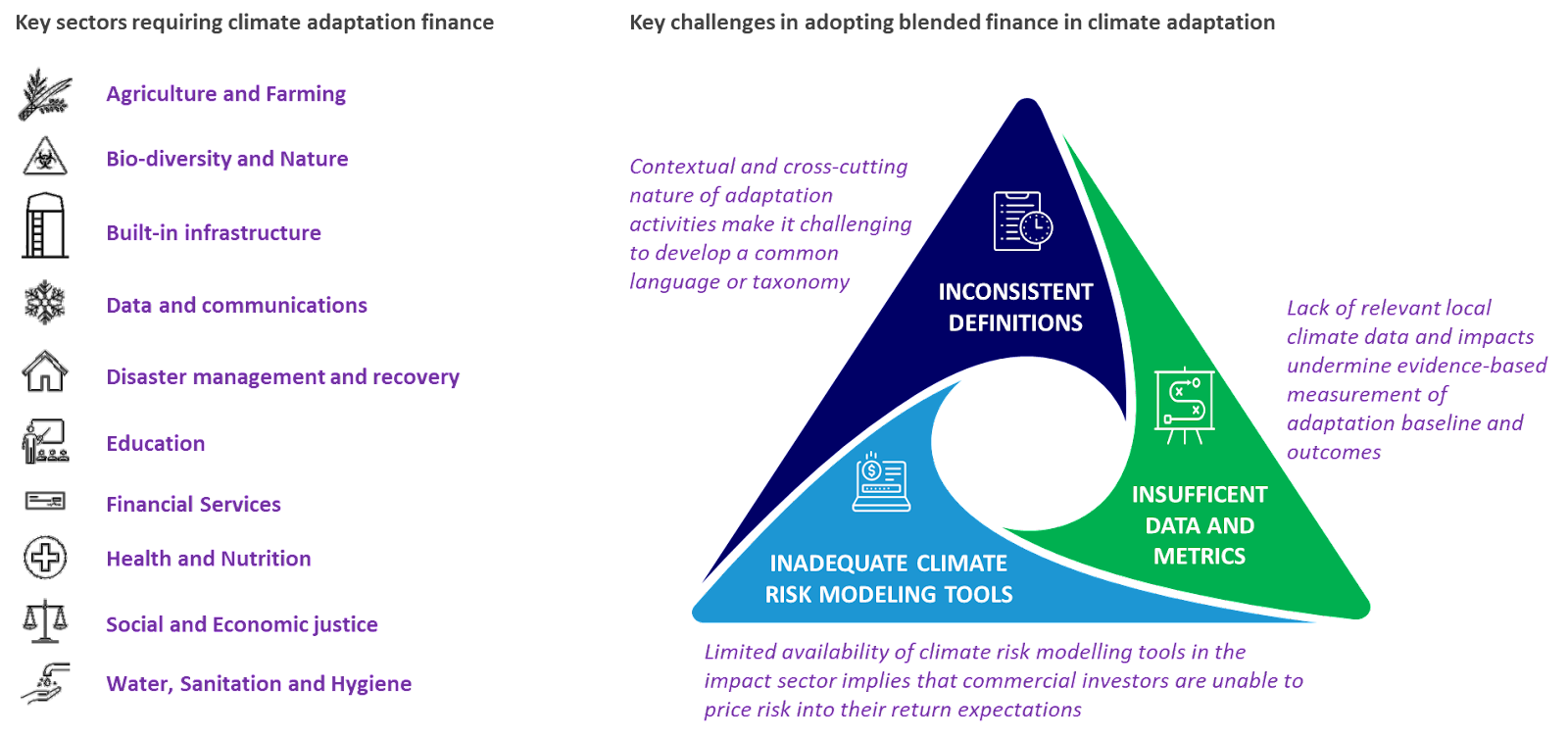
Source: Sculpt Partners
The first and the most important challenge is the lack of a globally consistent definition around climate adaptation. Unlike mitigation, which focuses on any project activity that contributes to GHG emissions reductions, adaptation is multi-layered and contextual. For example, climate smart agriculture can help farmers better cope with the effects of prolonged drought and extreme precipitation on crop yields. However, to be counted as adaptation finance the project should expressly take into consideration the local climate impacts and the needs of the vulnerable farmers in that region. Else it may be counted as development or blended finance in the traditional agri-farming sector. The OECD DAC Rio Markers, MDB Joint Methodology for Tracking Adaptation Finance and IRIS+ Navigating Impact are useful references for prospective investors interested in exploring different types of climate adaptation and resilience strategies.
A related challenge is the lack of granular data and metrics to support evidence-based measurement of adaptation outcomes. Numeric and qualitative measures of successful adaptation outcome(s) can be very specific to the nature of the project, the region(s) and stakeholder(s) impacted. For example, the Lima Adaptation Knowledge Initiative (LAKI) of the UN found that there is limited local data on water-related hazards (e.g. drought, landslide, debris flow, flooding, glacier lake outburst flood) and poor information on climate change impacts on key water resources.
Another important gap that stymies private sector participation in adaptation financing is the lack of climate risk models that can estimate the socio-economic impacts associated with climate change. Most climate risk tools today are built to serve the needs of corporations, financial institutions and insurance companies. We need more tools such as the WWF Water Risk Filter, CGIAR Agriculture Adaptation Atlas and CLIMADA that can help private investors appraise relevant risks in climate adaptation projects and price them into their expected rates of return.
Select case studies
Despite these challenges, there are encouraging market signals on the use of concessionary and commercial capital in adaptation financing. One such example is the Acumen Resilient Agriculture Fund that provides Technical Assistance (TA) programs, grant and equity funding to early-stage innovative agribusinesses that enhance the climate resilience of smallholder farmers in East and West Africa.
Lightsmith Climate Resilience is one of the first private equity funds to focus on climate adaptation and resilience by investing in growth-stage technology companies that address climate change impacts. By using donor capital as a risk-absorbing junior layer, it has helped attract $3.30 of commercial investment for every concessional dollar. The fund’s existing investments include a U.S. water tech company for renewable drinking water, an Indian food technology firm that reduces waste and enhances farm output, and a Brazilian AI company for climate-resilient agriculture.
The global impact investor, responsAbility launched a $106 million climate smart agriculture blended fund earlier this year, with climate adaptation as one of its three pillars. Through a first-loss tranche (that is sub-ordinate to the senior tranche), and a second-loss guarantee from Development Financial Institutions (DFIs), the fund offers a 25% protection against credit losses for private institutional investors and family offices.
Learnings for Indian impact investors
Based on our interactions with these pioneering investors, we have distilled three key lessons for the Indian impact eco-system:
- Establish a motivated anchor stakeholder (such as a DFI or a foundation), who in addition to providing concessionary capital, can take a long-term view, has appetite to experiment, brings to bear deep insights on intersectional impact systems and robust project governance models, and can influence political will to get impact initiatives off the ground.
- Pitch a wide tent, while building an investment thesis. To access a wider pool of funding from family offices, government and CSR sources, the impact narrative should consider and communicate co-benefits such as health, poverty reduction, and equity, among other Sustainable Development Goals (SDGs).
- While choosing impact enterprises or programs, seize opportunities where funding momentum and policy incentives exist. For example, investors interested in clean cooling solutions can draw upon existing work done by the Clean Cooling Collaborative and the Rockefeller Foundation, and can take advantage of government incentives for energy-efficient appliances.
In conclusion
By identifying a strong anchor funder, communicating the inter-sectional nature of impact and seizing policy and funding momentum, private investors can address the inherent challenges and catalyse the deployment of blended finance across climate adaptation programs in India.