Mobilizing sanitation credit through urban women SHGs to ensure access to Individual Household Toilets (IHHTs) -a case of MAVIM, Maharashtra
Introduction: The Swachh Bharat Mission (SBM) i.e. Clean India Mission in 2014, laid emphasis on sanitation and cleanliness in urban areas. Providing access to individual toilets has been one of the key components of the mission. But according to a recent state wide survey in Maharashtra, a large proportion of the respondents who completed toilet construction revealed that the SBM subsidy amount for IHHT was not enough to cover the entire construction costs. Taking cognisance from the demand created by SBM and the need for credit, Mahila Arthik Vikas Mahamandal (MAVIM) along with support from Center for Water and Sanitation(CWAS), CEPT University successfully demonstrated a pilot project in the city of Jalna in Maharashtra for providing sanitation credit to SHG women for construction of IHHT.
Partnership:
The project has demonstrated a successful partnership between MAVIM as SHG facilitators, SHG women as beneficiaries and loan borrowers and ICICI bank as financial institution. (refer Figure 1)
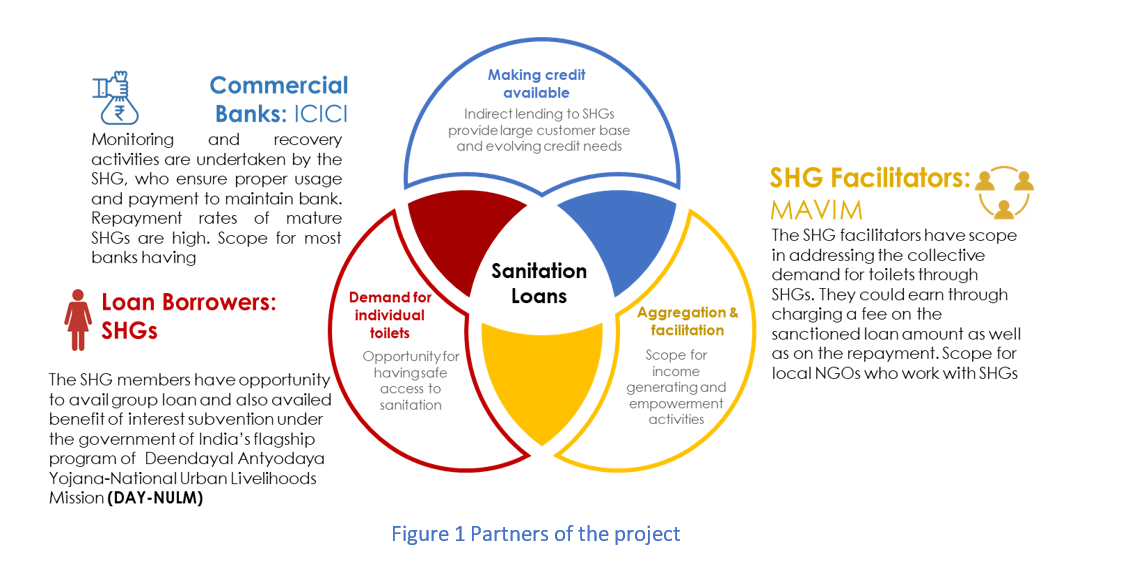
MAVIM is State Women Development Corporation of Maharashtra which is administered by Women & Child Development Dept. of Maharashtra. Objectives of MAVIM is mobilizing and building organization of women, enhancing capacities and making credit and markets accessible to them.
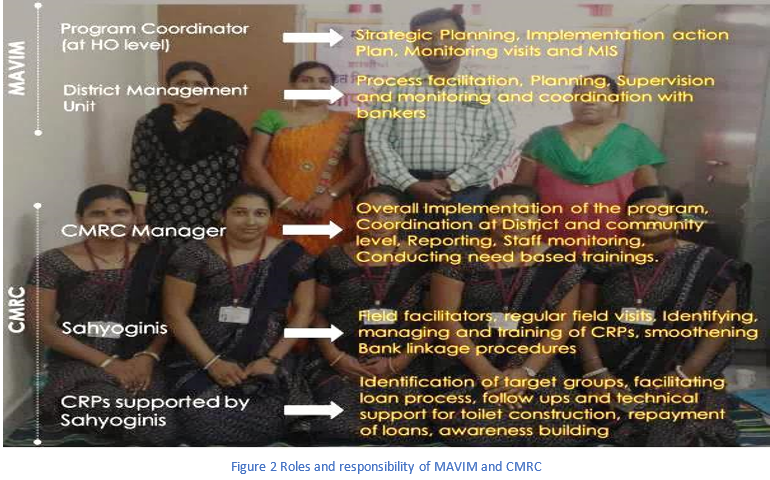
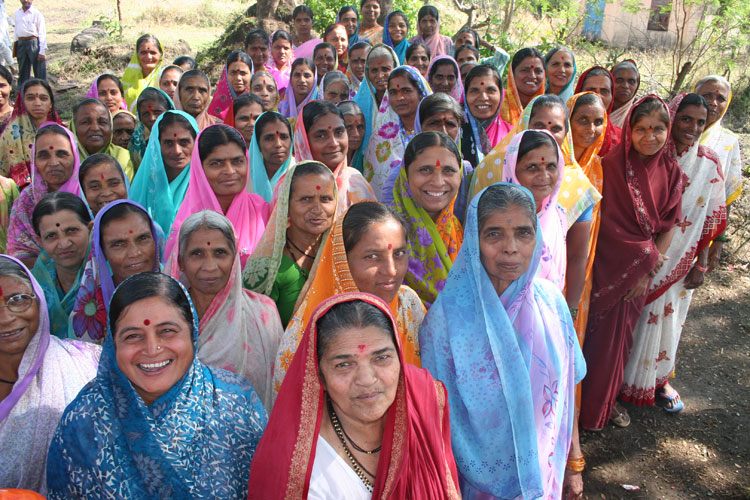
The role of the MAVIM and CMRC (Community Management Resource Centres) which as the aggregator for the toilet loan has been crucial in this project. MAVIM has been highly successful in forging partnerships between CMRCs and scheduled commercial sector banks. The model pilot project has successfully leveraged the CMRC to mobilize sanitation loans for 260 women. The Sahyoginis (Heath Coordinators) and Community Resource Persons (CRPs) supported by CMRC Manager and District Co-coordinating officer (District Management Unit of Jalna) were the key field personnel for successful implementation of this programme (Refer Figure 2)
Implementation process: A five-step process was followed for implementation of the project. This was developed based on field experience of MAVIM for similar projects. It included key steps like demand generation, mobilizing toilet loans from banks, providing technical support for toilet construction and ensuring timely repayment of loans to banks.
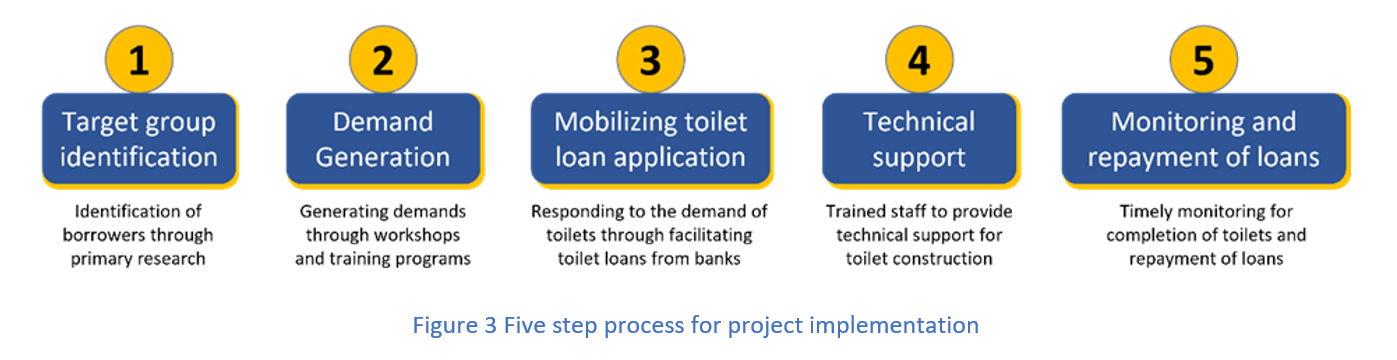
According to the primary survey conducted by MAVIM-CMRC team it was found that there is a demand for individual toilets mainly in slum areas of the city. Under the National Urban Livelihoods Mission (NULM), an operational network of MAVIM-CMRC SHGs was established.
Mobilizing toilet loan application:
Before initiating the mobilization process, demand generation activities were conducted. To orient women on importance of constructing IHHTs, these sessions were mostly conducted in the slum locations. The sahyoginis of the CMRCs undertook the task of mobilizing the loan applications as part of their daily field work. They also support the interested women in the documentation process for availing the loan. Meetings were arranged by the CMRC of the interested SHG women and with ICICI Bank. Loans for IHHT were disturbed during these meetings.
The SHGs were eligible for an interest subvention of 7% on the loans that they borrow from the bank. An additional 3% of interest subvention is applicable since they are women SHGs. Hence the rate of interest from the ICICI Bank is effectively only 4% which is very reasonable for the SHG women. The payments for the interest subvention is done on quarterly basis by the municipal council. The payment is deposited in the loan account of the SHG with the Bank. Regular repayment for 3 months must be done by the SHG to be eligible for interest subsidies.
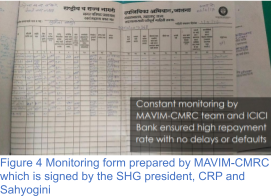
Monitoring and repayment of loans: Following the commencement of toilet construction, the Sahyoginis and CRPs monitored the progress of the toilets and the repayment of loans. A format was designed to monitor the progress that included: SHG name, number and name of members, and details of internal loans borrowed and repayment profile. The monitoring form is signed conjointly by the SHG president, CRP and Sahyogini. Together with MAVIM-CMRC, ICICI Bank also played a crucial role in ensuring timely payment of instalments with minimum delays. 90% of the loans are already being repaid.
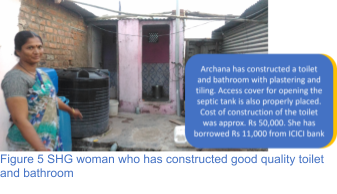
Impact: By August 2018, 207 loans have been mobilized out of 250 loans committed under the project. Average cost of construction is approximately Rs 45,000, as most women aspire to construct a toilet and a bathroom. Loans have been mainly borrowed from ICICI Bank and other scheduled commercial banks.
Most women have preferred to construct good quality ‘durable’ toilets using in-situ construction. Many have managed to overcome the space constraints and have added toilets, despite their small houses. Those who were able to afford and had space, have also added bathrooms. The project of sanitation credit for SHG women in Jalna is a true example of how access to sanitation credit can lead to a positive impact on the lives of women and their families.
Given the need for sanitation credit in future there is an opportunity to scale up this model across the state aligning to local conditions and requirements. Role of financial institutions and SHG facilitators would be the key factors for model to succeed.
MAVIM has a strong presence in Maharashtra with over 50 CMRC in urban areas. These provide an excellent opportunity to scale up sanitation credit for SHGs in urban areas. Such credit will help households to gain access to good quality individual toilets and help move urban Maharashtra towards universal access to improved household sanitation. Based on the experience from the sanitation credit model in Jalna, MAVIM is scaling up these ideas across 10 Urban CMRC in Maharashtra.
Author:
Centre for Water and Sanitation (CWAS) – CEPT Research & Development Foundation (CRDF) – CEPT University