Blended Finance to Enhance Private Sector Engagement in the Indian WASH Ecosystem (Part 1)
Anirban Chatterjee,
Senior Manager, Water, Sanitation, and Hygiene (WASH), RTI International India.
Nutan Zarapkar
Director, Water, Sanitation, and Hygiene (WASH), RTI International India.


RTI International is an independent, nonprofit research institute dedicated to improving the human condition. RTI's vision is to address the world's most critical problems with science-based solutions in pursuit of a better future. RTI has been working to help India address its enduring and emerging development challenges since 1982. Combining scientific rigor and technical proficiency, RTI delivers reliable data, thorough analysis, innovative methods, novel technologies, and sustainable programs that help clients inform public policy and ground practice in evidence.
India requires AU$ 250 bn. to achieve its SDG 6 goals by 2030. Of this, 70% is expected to arise from private sector sources. Blended finance can be an effective instrument to mobilise private finance; however, its adoption in the water, sanitation and hygiene (WASH) sector, for supporting infrastructure development and programs, has been miniscule globally and in India.
Developed by RTI International, under the Australian Government's Water for Women Program, the part 1 of this knowledge series aims to unearth reasons for limited private sector financing, esp. in WASH infrastructure, and list prevailing options in India for blended financing in WASH infrastructure projects and how these can be scaled up.
Systemic Challenges of the Private Sector across Stages of WASH Infrastructure Project Development
Design Stage: Project design continues to be unilaterally undertaken by relevant government agencies. This usually results in untenable expectations from the private sector like short delivery timeline, unrealistic penalty clauses, skewed payment terms, etc. Additionally, project design often fails to consider emergence of innovative technology and continues to retain tried and tested low-cost solutions.
Procurement Stage: Private sector start receiving detailed information of the project at this stage, i.e., when most technical parameters are frozen and there is little scope for exploring private sector recommendations. This creates gaps in communication, information and project appreciation between the public and private sector. At the same time, proposed bidding terms have often made it difficult for Small and Medium Enterprises (SMEs) to qualify or place themselves competitively against larger and more well-established players.
Construction and Operations Stage: Delays in land acquisition, design approvals, regulatory clearances, etc. result in cost overruns for the private sector. Delayed payments is another significant challenge for private sector project developers and investors. These financial risks hinder debt raising processes. Equity investors, even if they do agree to higher risks, are unclear about exit options and project returns. Availing blended finance options also remains a challenge as such options are miniscule and financing institutions, offering these solutions, continue to deploy conventional due diligence and risk estimation mechanisms.
Potential Solutions to Enhance Private Sector Investment
Engaging private sector as project co-developers: The government should explore ways to undertake ongoing private sector consultation starting from the design stage. The objective would be to secure public-private convergence and co-develop projects by understanding each other concerns, and brainstorming potential solutions. While the government may not be in a position to accept all suggestions, such consultations will help unearth opportunities and resources (finance, technology, knowledge, etc.) from private sector. Similarly, for private sector, it will help address some of the information gaps, reduce risk, and potential cost overrun.
Enhancing bankability of WASH projects: While efforts are being undertaken by the government to reduce the financing gap through CAPEX & OPEX efficiencies, mobilising tariffs, taxes, and transfers are equivalently important. There is an urgent need to rationalise citizen expectations towards tariffs and taxes, which will help the government enhance their WASH budget and repay the private sector.
Scaling-up blended finance ecosystem: Blended finance facilities from donor and multilateral agencies can provide security to private sector and encourage private investment. Blended finance instruments, like concessional debt/ equity, technical assistance, credit guarantees, etc., should be developed to leverage private sector investment. This is further described in the following section.
Blended Finance Options Available for WASH Infrastructure Development in India
Loss Guarantees: A Loss Guarantee is a loss sharing facility in which a guarantor of funds, in the event of project loss, reimburses a pre-determined portion of the repayment due to the financier. Such guarantees are additional because they provide significant coverage to the financiers' risk and enhances project's ability to secure/ raise finance.
Hybrid Annuity Model (HAM): The HAM has been recently introduced in the WASH sector to balance public-private risks in infrastructure development. Adopted in the World Bank-supported Namami Gange program which aims to prevent disposal of untreated sewage and arrest pollution in River Ganga, the government will contribute to 40% of the project cost (CAPEX). The balance 60% will be paid, to the private sector, over the life of the project as annuities along with operation and maintenance cost expenses (OPEX).
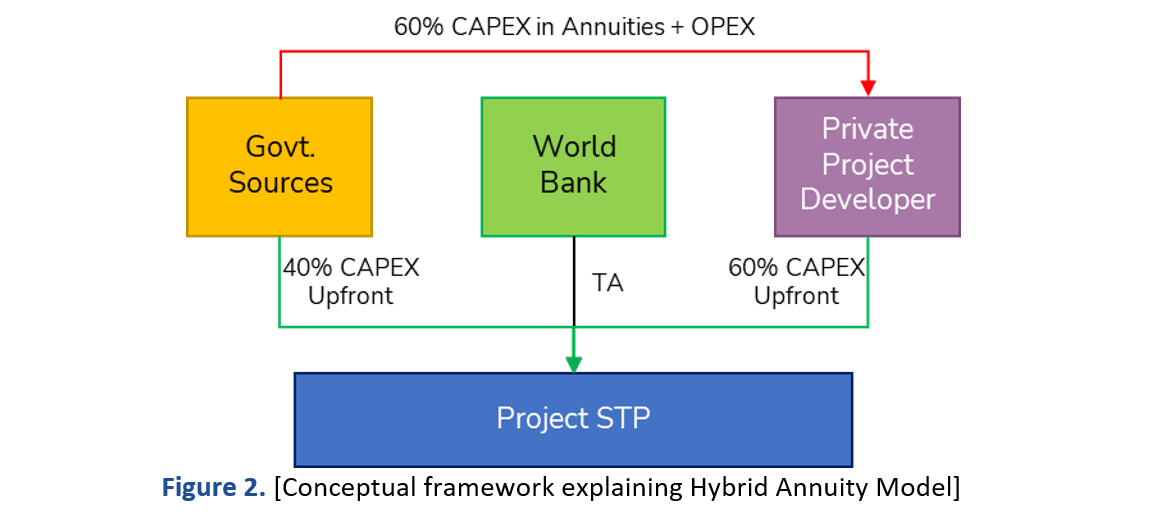
This financing model gives liquidity to the developer and the financial risk is shared by the government. In other words, the HAM model is additional as the government contribution provides adequate confidence to the private sector to invest the remaining capital investment.
Viability Gap Funding: Viability Gap Funding (VGF) usually refer to a grant one-time or deferred, provided to support infrastructure projects that are economically justified but fall short of financial viability. Additionality of VGF exists as such grants enhances project viability to an extent where it can attract commercial finance.
For example, development goals expected of the AU$ 93 mil Chandigarh 24x7 water supply project include improved women's lifestyle and health due to greater household water availability and improved water availability to economically weaker section. However, given that cost recovery from economically weaker sections of the society would be challenging, the European Union agreed to extend a grant valued to ~17% of the project cost. The balance funds are planned to be raised from Agence Francaise de Developpement/ AFD (72%), as loans, and internal government sources (11%). The project is currently awaiting sign-off from the Govt. of India.
Options Suggested for Scaling-up Blended Finance in WASH Sector of India
1. Even projects financed through blended funds, some of which have been described above, require dependable cost recovery options; identifying such options or enhancing dependability of these cost recovery options can help existing blended finance facilities to be extended to greater number of projects.
2. While strong project bankability assessment frameworks exist, there is scope to significantly strengthen capacity of financial institutions, in aspects of market limitations and opportunities, and blended finance options.
3. Philanthropic capital in India, valued in excess of AU$ 10 bn. annually and utilised majorly for WASH programs, could be leveraged to set up concessional finance structures towards WASH infrastructure development.