Caspian Debt Blended Finance Partnership for Nano Entrepreneurs
Launch Year: 2020
Instrument(s): Portfolio Guarantee
Target Geography(s): India
Target Sector(s): Financial Inclusion
Target Financial Size:INR 150 cr
Key Stakeholder(s) + Role(s):
- Philanthropic Partner: Michael and Susan Dell Foundation - The Guarantor
- Risk Investor: Caspian Debt- The Lender
Executive Summary
Nano-entrepreneurs, are 'people who typically run small retail or kirana shops, are micro wholesalers, or earn a livelihood as street vendors. They have not had the benefit of receiving a college education, which prevents them from attaining formal means of employment'. Enabling them is an important element of livelihood support systems in India. However, access to finance for them has always remained a challenge due to their small and vulnerable businesses and lack of formal credit profiles.
A significant impact of the Covid induced lockdowns and supply chain disruptions was the shutdown of numerous such nano-enterprises across the country. This led to a loss of livelihoods for millions, especially in the urban and semi-urban areas where government support systems like rural employment guarantee schemes are not available. These enterprises needed financing support to sustain and rebuild after COVID-19.
.jpg)
Financial Structure
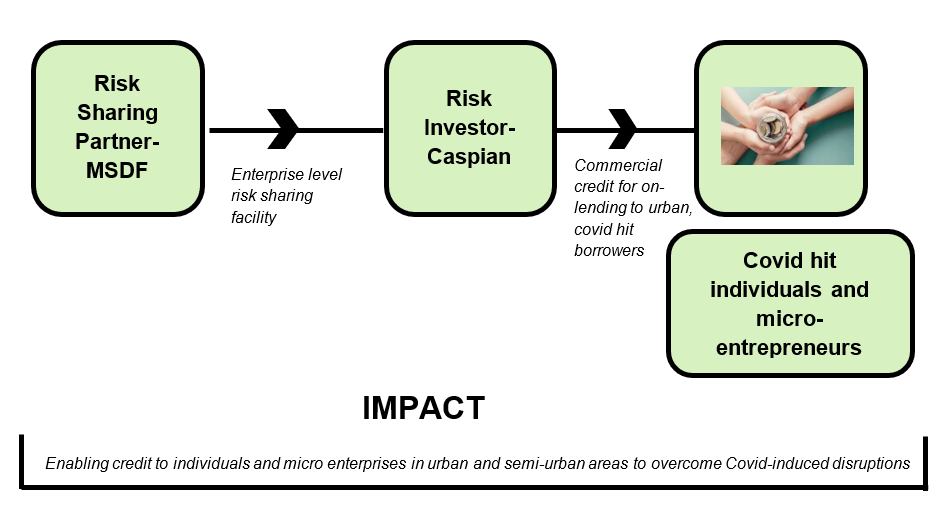
Being a prominent player in India's impact landscape with 17 years of group experience and 9 years of NBFC experience, Caspian Debt has the unique ability to source credit assets with high potential for impact. However, as a regulated lending entity, risk taking ability is limited by the nature of these unbanked credit assets. This is where a credit guarantee by a philanthropic partner helps enhance the risk-taking ability of Caspian Debt, thereby creating a large-scale impact. Availability of guarantee also helps Caspian Debt in raising funds for a non-collateral based lending which is considered risky.
Key Insights/Learnings
Partnerships foster scale: The risk investors have the ability and the commercial acumen to identify commercially scalable business models among the impact sectors. On the other hand, the philanthropic partners create the risk sharing mechanisms where markets fail. Therefore, the partnerships among the philanthropic and commercial players for targeted interventions can help bring commercial scale to the impact sector.
Portfolio approach with clearly defined mandates: If the impact mandates are clearly defined and a portfolio approach is taken towards scaling that, it is possible to generate high impact. To achieve this, work needs to be done to identify and measure key indicators which can help establish the causality between the intervention and the impact.
Impact to Date
The risk sharing partnership that we created helped us on-lend to our retail lending partners who in turn are directly lending to the identified nano-entrepreneur segments in urban and semi-urban areas. As a result of this partnership, Caspian was able to support 17 Non-Bank Finance partners, to provide loans of ticket sizes up to INR 300,000 to target end beneficiaries. This resulted in benefitting more than 600,000 nano-entrepreneurs across India.