Two of the Same Kind: CSR Funds and Blended Financing
Earlier, signing a cheque and hoping for results was common in the social sector. In order to optimise the impact on the ground, innovative funding methods are required. Innovation is required to maximise philanthropic contributions. Private corporations have the capacity to tackle social issues and work for larger public good. It could be through building up communities, uplifting marginalised communities and accelerating sustainable development. Long-term effect can be made possible by expanding small businesses’ access to inexpensive funding and alternatives with wider reach.
In addition to conventional grant-making, blended finance is a useful instrument for multilateral organisations, philanthropic groups, and Corporate Social Responsibility (“CSR”) foundations to invest their funds in initiatives that generate both financial and social returns. Growing foundations with adequate skilled staff employing innovative mechanisms in their structure and project implementation, including the Michael and Susan Dell Foundation, Open Society, and the Children’s Investment Fund Foundation, have been capable of narrowing the risk appetite gap and subsidising financial risk through grants or other low-cost reusable capital in order to direct commercial capital toward developmental projects.
In addition, blended finance offers an innovative avenue for commercial investors to switch to funding in the sector using approaches that are comparable to new methods once they are effective and feasible. This eventually results in an increase in the total amount of capital invested towards targeted social issues.
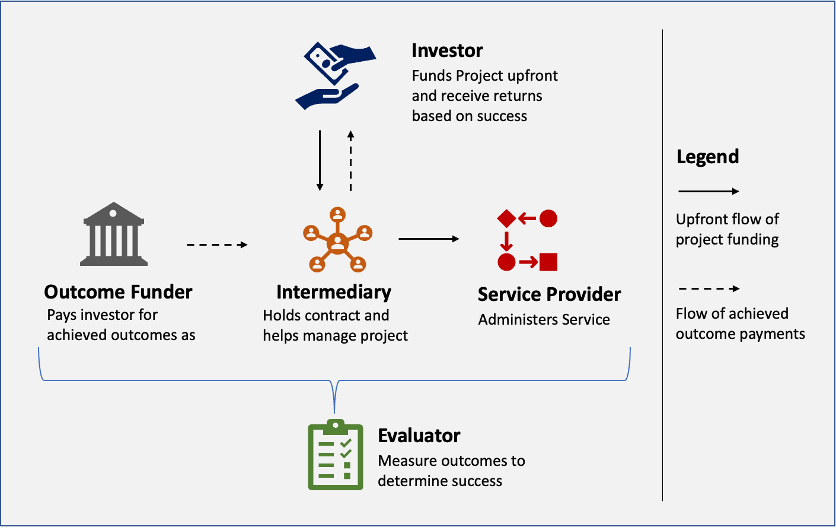
Albeit the fact that CSR corpus is only makes up a small portion of India’s social sector investment. This gap is attempted to be filled by the outcome funder model. In order for the outcome funder to satisfy the enterprise’s responsibilities, a “pay for success” model is employed. Herein, the project/investment is independently the pre-defined outcome metrics must be objectively evaluated by third-party evaluators for on-the-ground achievement. This makes sure that charitable resources are utilised in a way that will help produce results that are considerably greater than what direct spending is possible capable of.
Blended finance is gaining momentum in India and is now anticipated to be adopted more widely. The Indian government recently said that it would adopt a mixed finance strategy, but no movement has yet been taken or implemented.
However, proper initiative must be taken by the CSR funders by adapting blended finance tools to their CSR guidelines for obtaining additional funding. Under the Nadu-Nedu (before-after) initiative, the Government of Andhra Pradesh has increased CSR money while using a blended finance model to upgrade the infrastructure spanning 17,000 schools in the state. Through outcome-based funding and blended finance, the social effect created by CSR may be more effective and catalytic. By utilising philanthropic money to unleash commercial resources for the project, blended finance empowers initiatives to become more widely adopted and long-lasting.
The objective is to offer better results and magnify impact for underprivileged communities through enhanced leverage of money spent for CSR programmes. By releasing private or commercial resources to complement CSR funds in regions that are generally underserved or underfunded, CSR funders can multiply their impact and encourage a bigger inflow of funding for social development initiatives. As an alternative, corporations can boost the leverage of CSR funds by recycling or revolving money, which will enable a larger social return by having a greater influence on recipients.
In the end, imperatives like climate change, greenhouse gas emissions, replacing the import price of fossil fuels, and promoting economic growth through “green sectors” will call for a rapid scaling-up of sustainability projects. Innovative methods of raising green capital would be essential to achieving this goal, particularly given that Indian banks frequently are unable to finance sustainability initiatives due to their lengthy maturities. While integrated finance cannot eliminate all problems, it may undoubtedly remove some obstacles. The models covered in this article have previously proven to be valuable, making them worthy of imitation. The majority of them have the potential to be duplicated and scaled up even more in order to help India meet its many sustainability concerns. Emerging markets facing difficulties akin to those India faces should also pay attention.
The Guarantco programme of the Dutch bank FMO, which provides local banks with partial credit guarantees, the Global Climate Partnership Fund of the German banks, which refinanced local banks’ green lending initiatives, and the Facility for Energy Inclusion of the African Development Bank, which combines commercial capital for small-scale energy access projects are all examples of how blended finance can mobilise commercial bank participation.
As part of obligations to society, corporations must utilise their CSR funds and expertise beyond just granting CSR funds to not-for-profits. With CSR funds deployed, corporations must re-envision traditional grant-making and developed a more catalytic method to produce a greater social return by unlocking additional capital, recycling funds, and placing a heavy emphasis on outcomes. We evaluated and co-curated solutions that make use of creative or hybrid financial strategies in order to optimise impact and make CSR funds more effective.
It builds a pipeline of social impact projects that are financially feasible and reduces reliance on government debt and sovereign guarantees while lowering risk premium through co-financing and co-investment.